Showing posts with label Machu Picchu. Show all posts

Monday, January 15, 2018

Winter to Summer - A Month in the Summer Hemisphere - Machu Picchu

There are few more iconic pictures of must see sights in this world than Machu Picchu.  We've had a few friends who have traveled there -- one couple our age who actually did the four day hike along the Inca Trail a few years back.  While their experience was way more strenuous than ours, the end result (minus the blisters) was undoubtedly the same - the wonderment of this location is truly world class.  

While it is a top ten must see sight according to Lonely Planet, Machu Picchu is a little off the beaten track for many more luxury focused international travelers.  Yet despite its remoteness for some, this same remoteness and the opportunity to hike an ancient mountain trail has made it a mecca for younger, adventure oriented travelers -- especially because food, entertainment, and hostel prices are so good for folks from dollar and euro based economies.

Like many other must see destinations in the world, Machu Picchu was getting trampled and adversely affected by the hordes descending (or more accurately, ascending) on it.  Beginning on 01 September 2017, the Peruvian government changed the ticketing scheme, limiting tickets to either morning or afternoon sessions.  While cutting down on the number of people spending all day on the mountain, it has also had the effect in increasing wait times to catch a bus for the hair raising ascent from the Urubamba River in Aguas Calientes up to Machu Picchu.  But before you get there, you gotta' get there...

Walking to the train from the parking lot

As noted in our last post, it is approximately a 1:45 hour long (non-stop) ride from Cusco to the train station in Ollantaytambo.  While certain times of the year you can catch the Peru Rail local train from Poroy (about 20 minutes from Cusco), we were catching our train on a beautiful sunny day in Ollantaytambo.


At the train station entry gate, you need to show your ticket to enter.  There are two different train companies - Peru Rail and Inca Rail - offering tickets.  Each company has three levels of trains ranging from basic to luxurious so take your pick.  We took the middle option -- Vista Dome -- on Peru Rail.  We waited for our train in the waiting room (designated by the green sign below), getting a cup of cafe latte and a surprisingly good empanada for our brunch time train.


If you are taking the top end Hiram Bingham train, you have your own waiting room and check in point.


The aptly named "Vista Dome" offers really good visibility of the scenery along the river valley.  The seats are two by two (we had some recline on one train none on the return train so this feature must vary from coach to coach).  Given a choice, you want to sit facing forward on the left side of the train going to Aguas Calientes (thank you Incas Expert Travel) and on the right hand side facing forward on the return trip.  This gives you a view of the river and the Inca walking trail both going and coming.  The Vista Dome trip is about 1.5 hours each way.  We took the 10:55 train which got us into Aguas Calientes about 12:30.  We were served both snacks and drinks by uniformed conductors enroute -- and on the return train the following day, we were treated to a dance (the very colorful gentleman below) and a fashion show of truly beautiful Andean produced clothing.  The products, skirts, shirts and jackets were all beautifully made of Alpaca wool but when you live in sunny southwest Florida, not very practical.


Sign indicating Inca Walking Trail
Stop along the Inca Trail
Walking from village to home along the tracks
After our 1.5 hour ride beside the river - a very angry river exhibiting an amazing velocity of muddy brown water in a never ending series of seemingly death defying rapids and eddies, we arrived in Machu Picchu.


We were immediately contacted by our Incas Expert Travel Representative who whisked us and our bags to their office where we met our guide, Peter.

Our guide Peter

Peter took us along to the bus station where our tickets were punched (scanned) for the hair raising 20 minute (probably 30 minutes at normal speed) bus ride up to the Machu Picchu monument.  As we swayed back and forth on the dusty roads, our first thought was of the crazy bus ride from the port of Sorrento Italy and the Formula 1 qualifying driver who had us hanging from the bars on each switchback up the hill.  Yes - we survived that ride and we survived this one too but dang, we were pretty wide eyed when we parked at the top.  In addition to the buses going up and down, there were hikers going up and down along the road which looked like no fun at all since the road was dusty so we saw a few bandanna covered faces as they "blurred" by us...

Honestly though, once you are up there and start you tour, all of that is forgotten as we listened to Peter talk about Hiram Bingham's "discovery" of Machu Picchu and what we've learned about this amazing city in the clouds since that date.  I think the thing I took away from our visit is that unlike many ancient wonders, Machu Picchu is actually an entire working city with upper class and middle class homes, growing areas, water culverts, religious areas, and astrological observatories.  In so many places worldwide it seems that only the religious buildings have survived the years, leaving us to wonder where and how the people who worshiped in these places lived.  I guess my closest analog to Machu Picchu would be Pompeii and Ercolano (Herculaneum) where entire living breathing cities were frozen in time by volcanic ash.

Another thing that we appreciated was learning how the Peruvian government is keeping part of the monument in original condition -- original condition being covered with trees that had grown on the mountain plateau over the centuries after the city was essentially deserted.  By keeping part of it in original condition, current and future Peruvian university students can learn the art and science of discovering, excavating, preserving their cultural artifacts.
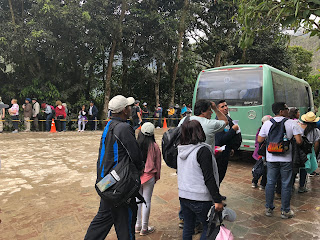
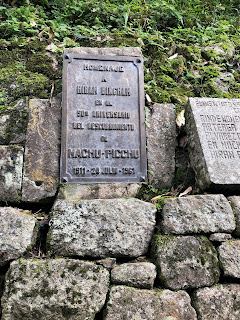
                Bus Turnaround up top


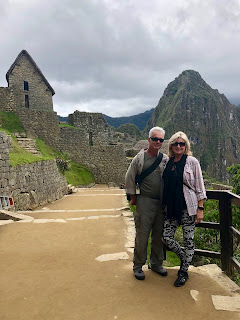
  The sun came out for our iconic vista shot


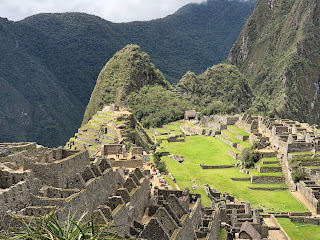
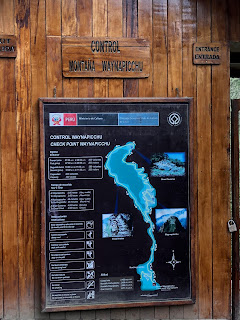
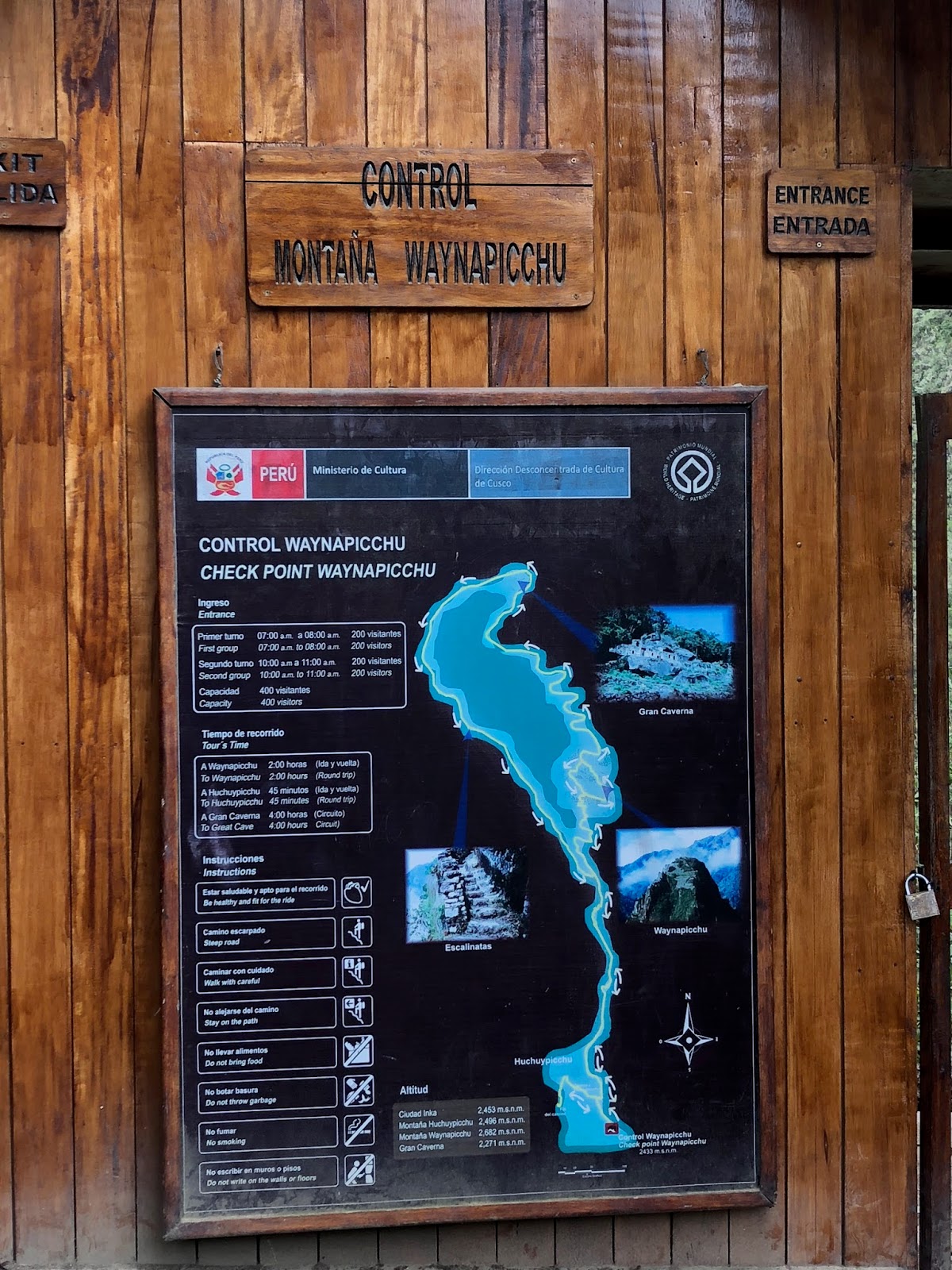
If you want a little added hiking and a breath-taking vista, you can do the Waynapicchu loop which according to the sign takes two hours.  The loop starts at the sign on the left and takes you up to the buildings in the top of the picture to the right.


That is the Urubamba River flowing through the valley below.  The food storage building in the picture on the right uses the exact same architecture as the one I'd seen in Ollantaytambo the previous day.


Pictured above is the Temple of the Condor

We must have taken several hundred pictures during our 4 hour guided tour with Peter so these are just a small sample of our cache.  Needless to say, Machu Picchu is now in our memory scrapbook, right up there beside our day long experience at the temples of Angkor Wat, emblematic of ancient civilizations that pursued art and science in such a way that they could build cities we marvel at today.  I think one of the things I liked best about our visit was that we got to see it as both a city in the clouds and a city in the sun, looking out over a forest of green to the river below.

After arriving back in Aguas Calientes, we headed to our hotel -- the Casa Andina Standard.  The hotel was nothing fancy but quite functional and the guy behind the desk was wonderful.  He upgraded us to the coolest room ever - right on the river - we slept with the windows open that night and were lulled to sleep by the white noise of rushing water.

View from our Casa Andina Room
With our bags stowed in our room, we headed out into town to see the sights.  Aguas Calientes is similiar to Ollantaytambo in that people are in town to sleep, eat, and see the nearby sights so there is a lot of hustle and bustle all hours of the day and night.

Monument in downtown Aguas Calientes
With a lot of tourist traffic in town, there are lots of restaurants to eat in.  The two we ate in -- Inka Wasi and the Inka Grill House.  We ate dinner at Inka Wasi and found the food to be wonderfully prepared, tasty, and a sight to behold as you can see in the picture below -- traditional Aji de Gallina.


We had lunch at Inka Grill House before we caught our mid-day train back to Ollantaytambo.  We were a little bit leery at first - Mexican food in Peru - but we lived in California for a long, long time so we had to give it a try.  We ordered Chicken Burritos and when they arrived, they looked a little different than we expected but they were really tasty.  If you've noticed a theme in Peru up to this point in our trip that would be that we were having really good meals regardless of where we were eating -- kind of reminds us of Italy -- another place where it's hard to have a bad meal.

Interesting Look but very tasty!

As we walked around Aguas Calientes, we snapped lots of pictures and we've added a few just to give you a feel for the local flavor.   The streets around the town were very clean and it is clear that they are spending money to put their best foot forward.  All in all, I wouldn't say that Aguas Calientes is a "destination" that stands on its own as a place to visit but it is a really nice place to hang out for a couple of days while you are taking in the wonder of Machu Picchu.


Our train ride back to Cusco and ultimately our flight back to Lima were smoothly handled by our Incas Expert Travel crew.  From a planning perspective, the only thing I would have changed was to have made our Sacred Valley tour an all day, one-way excursion, by checking out of our hotel in Cusco at the start of our tour, and checking in to a hotel or pension in Ollantaytambo and catching the same train the next day.  

This would have had us in Cusco for one night on the front end, a night in Ollantaytambo, a night in Aguas Calientes, and another night in Cusco - a total of four nights which I'd say is the minimum required to do a good job of seeing things and getting a chance to eat great local cuisine at night.  The other timing thing to consider are the trains you take back and forth.  The 10:55am train arriving Aguas Calientes at 12:30 gets you there in time to catch a bus for the afternoon Machu Picchu window.  While we could have gone back up the hill to see Machu Picchu the next day, this would have had us catching a train in the later afternoon -- 16:22 -- and getting back to Ollantaytambo around sunset and driving back to Cusco in the dark over somewhat sketchy roads.

After spending the time we'd allocated for this segment of our trip, and reflecting back now, we'd have spent at least 3 nights in Aguas Calientes to see Machu Picchu at sunrise and an afternoon hike to Waynapicchu.  We'd also spend three nights in Cusco, so with air travel back and forth, a week would be the ideal amount of time to see these sights properly.  If you are interesting in hiking the Inca Trail, it would probably be best to allocate an additional 6-8 days - 4 days for the actual hike and 2-4 days getting your altitude adjustment taken care of.

When we got back to Lima, we spent our last night at our new favorite hotel, the Belmond Miraflores where we were welcomed back like we were old friends.  The sun came out for our dinner with our Naples friends, Fred and Debi, who had arrived that day aboard Oceania Marina -- the ship that would be our home for the next 18 days of our adventure across the south Pacific.

When we planned our 7 day sojourn in Peru, we thought we were just "checking the box" since we were already going to be there to catch our ship.  As we sat down to dinner on our last night in Peru and reviewed what we'd seen and done with Fred and Debi, it was pretty clear to us and to them that we'd had one of our most memorable weeks ever.  Peru is now on our "Must Revisit" list...


Friday, January 12, 2018

Winter to Summer - A Month in the Summer Hemisphere - South America and South Pacific - Sightseeing in Lima


So, after our surprise of arriving and just loving Miraflores, our Belmond Miraflores hotel, and eating world class cuisine, now was our chance to see the highlights of Lima.

At 9am sharp, Gustavo from Incas Expert Travel and his driver, were waiting for us when we finished our Belmond breakfast, ready to conquer the world.

Kicking it with our guide Gustavo
One of the things we'd already groked in Lima is that a GPS may get you from point to point, but in a city growing as fast and large as Lima (11 million citizens and growing), you only get from point to point efficiently if someone who knows where the traffic tie-ups are and how to avoid them, is driving you.

Our first stop after traveling through Miraflores and San Isidro districts was Huaca Pucilana.


Huaca Pucilana is re-work in progress.  Built back in the 4th century A.D. it is now being restored, one brick at a time as our picture shows.  The guy at the bottom of the picture has a pile of bricks, which he is tossing to the guy in the middle, who in turn is tossing them to the guy in the top of the picture.  Once they have enough to complete another course, they start to work re-laying the ancient bricks.  In the picture directly below, you can see the completed courses and the unrestored courses above.  There is a lot of work to go but it is obvious that they are taking care to get things put properly back together to preserve their heritage.
Throwing 1500 Year old bricks 
Finished Product
Lima is truly a city of old and new.  It was a city in the time of the Pre-Incan and Inca eras, reutilized by the Spanish when they arrived and found Cusco to too difficult to run an empire from.  Today it is a mix of ancient, modern, and new with a clear mandate to restore and preserve their heritage.  At the same time though, Lima is experiencing the growth pains many countries are facing today as one third of the country's populace is now living in the greater Lima area.  Government services, infrastructure, and city planning are being challenged as more and more folks move from the countryside to find jobs in the city.  In addition to Peruvians, refugees from Venezuela and Bolivia are being welcomed and add to the influx.

Perhaps we didn't see the really "bad" areas in Lima on our travels around the city and surrounding districts but I can honestly say that while we saw some areas that were clearly less affluent than Miraflores or San Isidro, I didn't see any of the truly heart wrenching areas I've seen in other global urban aggregates where large numbers of people moving from rural areas to the metropolis are living in cardboard boxes and shipping containers under highway overpasses.

Another impression that will remain with us is that the Peruvian people living in Lima are into fitness and being outdoors.  Whether it was the number of folks taking surfing lessons right off the beach, work out classes in the parks or on the beach, and the soccer (football) players working out around pylons on sandy fields, it seemed like everyone is trying to stay fit amidst the hustle and bustle of city life.

As we drove into the city center, we were impressed by the well groomed parks, clean streets, and good looking architecture.  Turns out that the Historic Center of the city is UNESCO recognized proving once again that funding provided by UNESCO is put to good use by countries across the globe to preserve and protect their heritage for future generations and to the benefit of visitors like us.
Central Government Bulding

Empty Building

Paseo in the Shopping District

 The beautiful empty building above has an interesting story related to us by our guide Gustavo.  As many may remember, Peru in the 1980's faced many challenges.  Inflation was running 7000 (yes, three zeros)%, the Sendero Luminoso (Shining Path) guerillas were terrorizing the countryside, and lack of economic opportunity was creating an atmosphere of desperation - things were really bad.  As things in the city center deteriorated, the well-to-do folks living in this building and a number of others just like it, moved away to create new suburbs in San Isidro and Miraflores, leaving these buildings that were originally a mix of professional offices and apartments, completely empty.  While we couldn't see what the insides of these beautiful buildings looked like, the exteriors as evidenced in this picture show no external evidence of "urban blight".

In fact, I mentioned to Gustavo that as Lima continues to prosper and traffic into and out of the city's center continues to grow, I expect these buildings, bought up by far seeing and canny investors, will form the basis for the kind of gentrification we have seen in so many cities in the US and across the world.  Young urban professionals in Lima are already building smaller families than a generation ago so the large, single family homes sprinkled throughout the affluent suburbs won't be needed and the commute times to the City's center from the suburbs will continue to get longer.  There aren't any subways in Lima and making space for them amidst the growing pains of a city that was 300,000 25 or 30 years ago to one that exceeds 10 million today will be problematic.  It will be very interesting to see what happens in central Lima over the next 5 or 10 years.

Lima Cathedral
Everything in the Plaza de Armas is looking spiffy


Presidential Palace in the background
 Historically, Lima's connections to its time as a colony of Spain are treasured as part of their rich and blended cultural heritage.  As Gustavo walked us through the Cathedral of Lima, he pointed out the grave of Francisco Pizarro and walked us through the Peruvian equivalent of "Who's buried in Grant's tomb".  Apparently, a body on display for more than 100 years and believed to be Pizarro's was found to be someone else when the real remains of Pizarro were found in a long forgotten crypt.  Now both gentlemen are interred in adjoining crypts within the Cathedral.  As we walked throughout the church, Gustavo continued to point out interesting facts about what we were seeing and things we were seeing, but wouldn't have understood without his help.

Pizarro's Crypt
First off, the original construction of the church was in the traditional stone you'd see throughout Europe.  In fact, the church was built using an existing Inca temple as part of its foundation.  But unlike much of Europe, Peru is prone to earthquakes, so the vaulted stone ceilings came crashing down and were replaced by wood construction that was able to flex during earthquakes.  If we hadn't known they were built of wood, we wouldn't have noticed any difference to the hundreds of churches we've seen throughout Europe.


Next, there were slight variations in church symbology contained within the altars and magnificent paintings we could see on the walls.  These variations were deliberately added by Mestizo (mixed Spanish and Andean blood) craftsmen who did the actual crafting of the church's decorations and dedications.  Two particular examples stick in my mind...

First, the main altar was a combination of silver and gold.  While gold is the traditional color you'd expect to see in a Catholic altar, the silver worked into the design is a symbol of one of the Andean deities.  So the parishioners were getting a double blessing if you will.

The second example was a very large painting of the Last Supper hanging on the cathedral's wall.  Contained within the traditional scene of Jesus and the Twelve disciples were two local modifications.  First, one of the disciples was brown and rather than looking at Jesus, is looking directly at you, and second, the meal in the centerpiece of the scene was actually a guinea pig, adding more local "flavor" if you will. I wish we had pictures but unfortunately, we couldn't take pictures in this part of the church.

While more than 80% of Peruvian people today are Catholic by religion, the heritage of Incan and Pre-Incan spiritual beliefs managed to survive 400+ years of missionary influence.  In fact, one of the reasons why everything looked especially spiffy and clean during our visit is that Pope Frances was visiting Peru the following week.  Ironically, as Gustavo pointed out, despite the fact that the Spanish sought to destroy all remnants of existing worship and beliefs (and did a pretty good job throughout Peru of doing so), they were also the best chroniclers of what they found when they arrived and encountered the empire of the Inca.  So much of what is known today of what existed when the Spanish arrived, was preserved in their journals.

What I took away from our visit to Huaca Pucilana, the Cathedral of Lima and later on, to the Convent of San Francisco is the seamless blending of beliefs and history between two very different peoples and cultures.  As evidenced in the people of Peru today, it is all part of their shared story not one that stopped 500+ years ago, nor one that reviles those that tore down existing temples and destroyed 1000 years of pre-existing civilization.  As related to us by Gustavo, school kids in Peru are taught their entire history, Pre-Inca, Incan, Colonial, and modern in one continuous thread since it is this history that flows in their blood today.


Wednesday, January 10, 2018

Winter to Summer - A Month in the Summer Hemisphere - South America and South Pacific - Staying in Lima

Day #1 

Let me start by saying that we hadn't set any expectations for our stay in Peru.  We were here to catch an amazing 18-day cruise and decided, with Rachel's help, to spend a week getting to know Lima, Cusco, and Machu Picchu.  Boy, are we glad we did...  We went from saying, "You know, we'll never be passing through these parts again, so better see all the highlights while we're here" to "When are we coming back next time?"  But I'm getting ahead of myself, what happened to change our mind?  Here we go...

Our arrival at the Belmond Miraflores started with "Wow" - no other way to describe the understated but obvious elegance of the hotel we'd chosen for our stay in Lima.  

Hotel Arrival


Beautiful Lobby
Andrea Denegri from Guest Relations checked us in and then made everything we needed or desired, happen.  This included getting us lunch reservations at Central - a top "5" in the world restaurant - for the following day, dinner reservations at Fiesta Chiclayo Gourmet for our first meal in Lima, and her own recommendations for dining in Cusco when we headed that direction.  After Andrea worked her magic, we were greeted by the hotel's general manager, Thomas Moons, who introduced us to his hotel and made our arrival at the Belmond Miraflores complete.  Well, almost complete, Thomas mentioned we'd been upgraded and then between he and Andrea, they arranged for the marine layer to recede just in time for our first sunset in Peru, overlooking the beautiful park full of joggers, lovers, and happy dogs...
Our beautiful corner room - #704 

Miraflores boardwalk

Mall Overlooking the Pacific

A drink with dinner perhaps?
Our first impressions of Miraflores were so positive...  We walked a short distance from the hotel to a nearby mall to find an ATM to get some Peruvian Soles for our visit.  On the short walk through the park fronting the Belmond, we passed so many happy people along the way from small classes of people learning Brazilian martial arts, to dog walkers with 6 or 8 dogs on their leashes out for an afternoon stroll.  After walking perhaps 3 or 4 hundred yards, we arrived at the mall - hustle and bustle of well dressed people of all ages - surrounded by stores we'd see back in the USA with restaurants of every cuisine, all with amazing views of the Pacific Ocean.  With a little help from a mall security guard we found the promised ATM and proceeded to get some Soles as planned.  The ATM had a choice of English or Spanish text so running through the normal sequence of selections was as easy as it is at home.  On second thought, perhaps I should start practicing at home using the Spanish option, and save the English option for the road, but I digress...


In addition to the wonderful people hosting us at Belmond Miraflores, we were also fortunate to get tour of the entire hotel from Jorge Carrera from Sales and Marketing.  Jorge showed us rooms in both traditional and modern motif - both beautiful in their own way - and most importantly, the Club Floor.  The Club Floor hosts an Executive Club set up to provide for both business people (fully appointed conference room) or international travelers arriving or departing outside of normal check in/check out hours and wanting a nice place to shower, eat, or rest until their room is ready or their ride to the airport is leaving.
Club Floor Entrance

We also sampled both food and drink at the Belmond...  Andrea had given us the heads up that breakfast was not to be missed.  She was so right.  For $15 US each, we ate in one of the best breakfast environments we've ever visited.  The food was magnificent, fresh, and varied making this one of the best values ever.  And the view?  On one side was a disappearing edge pool and on the other, was a view of the park and a Catholic Cathedral.  

Disappearing edge pool overlooking the Pacific
Buffet Spread


Fresh honey with bee pollen

Breakfast View
So with breakfast well taken care of, what about dinner and drink?  On Thursday nights, Thomas and his staff host a Manager's Happy Hour.  Each of the guests attending the Happy Hour had the chance to meet and chat with hotel staff and in doing so, take a true measure of the hotel and its personality.  Andrea shared tips and restaurants about Cusco and Machu Picchu while Eric showed us around the restaurant, explaining each piece of art and the concept of changing the art through the restaurant several times each year.  Meanwhile Renzo the head bartender created our first Pisco Sours in Peru.  After Happy Hour, we had a great dinner served on the patio, capping a perfect day in Lima.


Happy Hour


Belmond Patio Dining


Renzo shaking a Pisco Sour


Inside Dining    


Our First Pisco Sour

 
While many of the people who host you - whether in a hotel or on a cruise ship - are those you get to talk to and interact with - there are other folks who we don't always see who make their presence felt in other ways... 


In this case it was a member of the Belmond's housekeeping staff who helpfully rearranged our toothbrushes and toothpaste while we were out to dinner.  This small kindness was emblematic of our stay - every thing and every one was perfect.  We couldn't imagine staying anywhere else the next time we visit Lima.

From a travel tip perspective, the Belmond was the first part of our baggage bread crumb plan.  We were packed for a 32 day trip with an 18 day cruise in the middle.  So we arranged our cruise clothes into our big bags and left everything we wouldn't need for our Cusco/Machu Picchu visit at the Belmond.  In Cusco, we left our two carry on rollers behind with everything we wouldn't need for our train trip to Aguas Calientes, tour of the Machu Picchu monument, and overnight stay in Aguas Calientes.  Our bread crumb plan worked perfectly as we picked up each piece we'd left behind in Cusco and then at the Belmond, greatly simplifying the task of luggage and "Trains, Planes, Ships, and Automobiles".

Next up, a transition from world class accommodations to world class dining --did you know Lima may be the world's new number one city for dining?