Showing posts with label Oceania. Show all posts

Saturday, January 13, 2018

Winter to Summer - A Month in the Summer Hemisphere - Heading to the Highlands of Peru

After the wonderful surprise of Lima, we headed from the coast to the mountains of Cusco; 11,000 feet worth of mountains to be exact -- a fact we were reminded of as soon as we got off the plane and went up and down a flight of stairs.

Our trip started with a transfer from the Belmond back to the Lima airport for our 1.5 hour trip, via Avianca, to Cusco.  The ride from Miraflores to Callao took about 45 minutes - noting once again that knowing how to get from point A to point B is less important than avoiding traffic tie-ups along the way - which our driver adroitly did.  On the road to the airport, we made a quick stop at a Lima pharmacy to pick up a prescription medication we couldn't get before we left Naples.  Five minutes later, we were back in our car with the required medicine, for a total cost of $2.37 - we didn't need the actual prescription, we just needed the name.  

The flight from Lima to Cusco was uneventful - the contrast between the arid coastline around Lima and the verdant valleys surrounding Cusco was immediately evident.
Cusco - a city surrounded by hills
As we were coming to expect from our Incas Expert Travel host, our driver and guide were waiting for us as soon as we picked up our bags and off we headed to our hotel, the Hilton Garden Inn, located in the Cusco hills adjacent to the Plaza de Santa Ana, and a short walk or taxi (6 Soles - less than $2 USD) ride to the Plaza de Armas - the center of historic old town Cusco.

Our guide Mary
Plaza de Armas


After getting our bags settled in our room, we headed out on our tour of Cusco, hosted by Mary from Incas Expert Travel.  Mary would spend the next three hours helping us understand old town Cusco, while taking us back to the time before the Spanish arrived.  Starting our tour at the Plaza de Armas really gave us a feel for Cusco's vibe -- a combination of restless energy with hustle and bustle in North Face and Patagonia fashions.  So we'd have energy for our afternoon tour, we started with lunch at the Inka Grill and a traditional Peruvian plate of Aji de Gallina.  

We accompanied our lunch with a cup of Mate de Coca (Coca Tea) to help alleviate the slight effects we were feeling of the rapid altitude change. After lunch Mary walked us over to the Convent of Santo Domingo and the Temple of the Sun -- Qorikancha.  As we'd seen in Lima, when the Spanish arrived, they immediately began a "redevelopment tear down" of the existing Inca temple as the basis for their own church.  And in cases where they didn't actually tear something down, they covered it up with frescos or paintings.  500+ years later when the original Spanish construction was getting re-done, they discovered the underlaying Inca era architecture covered in many cases with plaster and frescos.


Qorikancha/Convent of Santo Domingo


Inca era stone work used as a foundation for the Convent of Santo Domingo uncovered during rework of the Spanish era construction. 


15th Century Frescos discovered during renovation


Fields of potatoes

F
After a great hour or so touring old town Cusco, we went back further in time to the hills surrounding Cusco; back to the Inca empire and the Saqsaywaman archeological area (or as a wag would comment later, "Sexy Woman").  While we were on the way there, Mary talked to us about the importance of potatoes, their cultivation, and the tremendous number of varieties grown in and around this part of Peru.  Mary was so knowledgeable about Peruvian history and able to explain the relevance and context of everything.  After having Gustavo guiding us through Lima and now Mary taking us through Cusco, we realized how important it is to have a quality local guide to understand how history has brought us to where things are today.  Moreover, this was the first time in all our travels we'd made the conscious effort to engage a local travel agent -- Incas Expert Travel - to arrange for private guides in each venue.  As we'd find throughout our trip, our experience in Peru was immeasurably enhanced by having a personal and knowledgeable local guide.

You can read everything on the web or in a book, but neither convey the sense of how history, old and new, combine into a people, their outlook, and their sense of both heritage and future -- our personal guides were our docents into Peru and their unique combination of Andean and Spanish culture.  Carmen in Sacred Valley and Peter in Machu Picchu just reinforced the impression we'd now formed.  If we are going to spend money traveling to see new and unique places with storied histories, we're going to make sure we spend the time required to find and hire local guides who turn facts into memories and give names to impressions - Gustavo, Mary, Carmen, and Peter will be inexorably tied to our Peruvian experiences.

We provide scale for some of the structure...
Our primary take away from Saqsaywaman has got to be similar to the feeling of wonder associated with seeing other ancient structures like the pyramids in Egypt. How did they cut and move these huge stones to form such immense structures.  And in an era where 30 year old homes and 100 year old buildings are "old", these ancient structures have survived for almost 1000 years and still evoke wonder and reverence for the inspiration and hard work they represent.
To commemorate our visit to ancient Cusco, we stopped at Esmeralda Joyeria for some souvenir shopping.  The cool part of the shopping was the education we received on silver smithing and alpaca, llama, and wool grading.  We walked out with a very cool silver pendant and a baby Alpaca fur for our couch.

With sightseeing and shopping done in Cusco, its time to take a look at some of the places we ate while in Cusco.  While we had super, world class gourmet meals in Lima at Central and Fiesta Gourmet, I think we felt we had better food in Cusco.

Pizza at Bodega 138
Up first is Bodega 138, a craft beer and wood fired pizza restaurant just a half block away from the Plaza de Armas.  Bodega 138 was a "must visit" received from our Belmond Guest Relations buddy Andrea - we weren't disappointed.  After a long day of flying, sight seeing and shopping at 11K+ altitude, we were ready for pizza and beer.

Next up was a visit to Limbus Resto Bar - the #1 Trip Advisor rated restaurant in Cusco.  And as you'll sometimes find in Trip Advisor, "#1" doesn't necessarily translate into the best restaurant (or hotel, attraction, etc) but it generally does mean it's memorable and in the case of Limbus, this was certainly true.  First though, we had to find it and this wasn't an easy task since there weren't any signs.  With help from a couple of residents, we were able to find the little side alley where the entrance to Limbus is.  Once we entered Limbus and walked up the stairs, we could instantly see why it is rated #1 in Trip Advisor - the view of Cusco from Limbus is amazing.  The vibe is young and trendy -- good music and beer -- food wasn't memorable but who needs food when you are looking at the most romantic view in Cusco -- in fact, the majority of customers we saw were young couples on romantic dates.  No matter how hot the date though, no one could stay out on the patio for more than a few minutes after the sun went down.  Even in mid-summer, it cools off pretty fast at 11k feet, and the wind blows hard up the hill at Limbus Resto.  It was fun to watch succeeding couples happily sit down on the patio, end up getting a lap blanket next, and finally moving from the patio into the restaurant proper and behind the glass patio doors.


The best city lights view in Cusco
If Limbus had the most memorable view, Moreno Peruvian Kitchen had the best food we ate in all of Peru, a combination of fresh Peruvian ingredients cooked in a nouveau fusion style. We ate downstairs in an atmosphere not unlike that we'd experienced in Limbus - young people, moving with energy, lots of romantic couples, but this time rather than a heart stopping view, the cuisine, ingredients, and service were the main course.  Our server, Maria, was so good - taking care of everything perfectly - and when I made an order boo boo - she fixed it right away without complaint and complete grace.

Lima started our culinary experience in Peru - Cusco introduced us to some of the regional ingredients -- potatoes and quinoa growing in fields throughout the hills -- and Moreno showed us how you can turn the freshest local ingredients into remarkable meals.  Eating in Cusco reinforced what we'd found to be true in Lima - Peruvians take real pride in their food and prices -- relative to the dollar --- are amazing.

I started by talking about our altitude surprise when we got off the plane but truthfully, after a day hiking around Cusco, a cup or two of Coca and Muna tea (a local mint like herb with altitude ameliorating characteristics), we didn't have any problems sleeping or shortness of breath once we figured we needed to slow down.  The other considerations passed on to us by locals were ensuring we didn't drink any booze and eating easy to digest meals the first day since everything in your system slows down.  By the time we left the mountains around Cusco four days later, we had completely acclimated and were able to have wine with our evening meal.

Next up, an all day trip into the Sacred Valley


Rocks used for table setting


The ingredients were so fresh and delicious

Betcha these are Inca era foundation stones!

We were so glad to include Maria in our evening

Rock, Wood, and Trendy art

 
Cooks hamming it up for the camera


Friday, January 12, 2018

Winter to Summer - A Month in the Summer Hemisphere - South America and South Pacific - Sightseeing in Lima


So, after our surprise of arriving and just loving Miraflores, our Belmond Miraflores hotel, and eating world class cuisine, now was our chance to see the highlights of Lima.

At 9am sharp, Gustavo from Incas Expert Travel and his driver, were waiting for us when we finished our Belmond breakfast, ready to conquer the world.

Kicking it with our guide Gustavo
One of the things we'd already groked in Lima is that a GPS may get you from point to point, but in a city growing as fast and large as Lima (11 million citizens and growing), you only get from point to point efficiently if someone who knows where the traffic tie-ups are and how to avoid them, is driving you.

Our first stop after traveling through Miraflores and San Isidro districts was Huaca Pucilana.
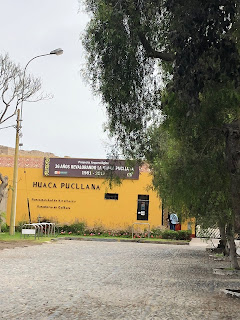

Huaca Pucilana is re-work in progress.  Built back in the 4th century A.D. it is now being restored, one brick at a time as our picture shows.  The guy at the bottom of the picture has a pile of bricks, which he is tossing to the guy in the middle, who in turn is tossing them to the guy in the top of the picture.  Once they have enough to complete another course, they start to work re-laying the ancient bricks.  In the picture directly below, you can see the completed courses and the unrestored courses above.  There is a lot of work to go but it is obvious that they are taking care to get things put properly back together to preserve their heritage.
Throwing 1500 Year old bricks 
Finished Product
Lima is truly a city of old and new.  It was a city in the time of the Pre-Incan and Inca eras, reutilized by the Spanish when they arrived and found Cusco to too difficult to run an empire from.  Today it is a mix of ancient, modern, and new with a clear mandate to restore and preserve their heritage.  At the same time though, Lima is experiencing the growth pains many countries are facing today as one third of the country's populace is now living in the greater Lima area.  Government services, infrastructure, and city planning are being challenged as more and more folks move from the countryside to find jobs in the city.  In addition to Peruvians, refugees from Venezuela and Bolivia are being welcomed and add to the influx.

Perhaps we didn't see the really "bad" areas in Lima on our travels around the city and surrounding districts but I can honestly say that while we saw some areas that were clearly less affluent than Miraflores or San Isidro, I didn't see any of the truly heart wrenching areas I've seen in other global urban aggregates where large numbers of people moving from rural areas to the metropolis are living in cardboard boxes and shipping containers under highway overpasses.

Another impression that will remain with us is that the Peruvian people living in Lima are into fitness and being outdoors.  Whether it was the number of folks taking surfing lessons right off the beach, work out classes in the parks or on the beach, and the soccer (football) players working out around pylons on sandy fields, it seemed like everyone is trying to stay fit amidst the hustle and bustle of city life.

As we drove into the city center, we were impressed by the well groomed parks, clean streets, and good looking architecture.  Turns out that the Historic Center of the city is UNESCO recognized proving once again that funding provided by UNESCO is put to good use by countries across the globe to preserve and protect their heritage for future generations and to the benefit of visitors like us.
Central Government Bulding

Empty Building

Paseo in the Shopping District

 The beautiful empty building above has an interesting story related to us by our guide Gustavo.  As many may remember, Peru in the 1980's faced many challenges.  Inflation was running 7000 (yes, three zeros)%, the Sendero Luminoso (Shining Path) guerillas were terrorizing the countryside, and lack of economic opportunity was creating an atmosphere of desperation - things were really bad.  As things in the city center deteriorated, the well-to-do folks living in this building and a number of others just like it, moved away to create new suburbs in San Isidro and Miraflores, leaving these buildings that were originally a mix of professional offices and apartments, completely empty.  While we couldn't see what the insides of these beautiful buildings looked like, the exteriors as evidenced in this picture show no external evidence of "urban blight".

In fact, I mentioned to Gustavo that as Lima continues to prosper and traffic into and out of the city's center continues to grow, I expect these buildings, bought up by far seeing and canny investors, will form the basis for the kind of gentrification we have seen in so many cities in the US and across the world.  Young urban professionals in Lima are already building smaller families than a generation ago so the large, single family homes sprinkled throughout the affluent suburbs won't be needed and the commute times to the City's center from the suburbs will continue to get longer.  There aren't any subways in Lima and making space for them amidst the growing pains of a city that was 300,000 25 or 30 years ago to one that exceeds 10 million today will be problematic.  It will be very interesting to see what happens in central Lima over the next 5 or 10 years.

Lima Cathedral
Everything in the Plaza de Armas is looking spiffy


Presidential Palace in the background
 Historically, Lima's connections to its time as a colony of Spain are treasured as part of their rich and blended cultural heritage.  As Gustavo walked us through the Cathedral of Lima, he pointed out the grave of Francisco Pizarro and walked us through the Peruvian equivalent of "Who's buried in Grant's tomb".  Apparently, a body on display for more than 100 years and believed to be Pizarro's was found to be someone else when the real remains of Pizarro were found in a long forgotten crypt.  Now both gentlemen are interred in adjoining crypts within the Cathedral.  As we walked throughout the church, Gustavo continued to point out interesting facts about what we were seeing and things we were seeing, but wouldn't have understood without his help.

Pizarro's Crypt
First off, the original construction of the church was in the traditional stone you'd see throughout Europe.  In fact, the church was built using an existing Inca temple as part of its foundation.  But unlike much of Europe, Peru is prone to earthquakes, so the vaulted stone ceilings came crashing down and were replaced by wood construction that was able to flex during earthquakes.  If we hadn't known they were built of wood, we wouldn't have noticed any difference to the hundreds of churches we've seen throughout Europe.


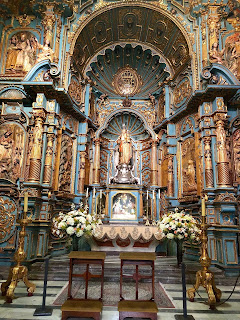
Next, there were slight variations in church symbology contained within the altars and magnificent paintings we could see on the walls.  These variations were deliberately added by Mestizo (mixed Spanish and Andean blood) craftsmen who did the actual crafting of the church's decorations and dedications.  Two particular examples stick in my mind...

First, the main altar was a combination of silver and gold.  While gold is the traditional color you'd expect to see in a Catholic altar, the silver worked into the design is a symbol of one of the Andean deities.  So the parishioners were getting a double blessing if you will.
The second example was a very large painting of the Last Supper hanging on the cathedral's wall.  Contained within the traditional scene of Jesus and the Twelve disciples were two local modifications.  First, one of the disciples was brown and rather than looking at Jesus, is looking directly at you, and second, the meal in the centerpiece of the scene was actually a guinea pig, adding more local "flavor" if you will. I wish we had pictures but unfortunately, we couldn't take pictures in this part of the church.

While more than 80% of Peruvian people today are Catholic by religion, the heritage of Incan and Pre-Incan spiritual beliefs managed to survive 400+ years of missionary influence.  In fact, one of the reasons why everything looked especially spiffy and clean during our visit is that Pope Frances was visiting Peru the following week.  Ironically, as Gustavo pointed out, despite the fact that the Spanish sought to destroy all remnants of existing worship and beliefs (and did a pretty good job throughout Peru of doing so), they were also the best chroniclers of what they found when they arrived and encountered the empire of the Inca.  So much of what is known today of what existed when the Spanish arrived, was preserved in their journals.

What I took away from our visit to Huaca Pucilana, the Cathedral of Lima and later on, to the Convent of San Francisco is the seamless blending of beliefs and history between two very different peoples and cultures.  As evidenced in the people of Peru today, it is all part of their shared story not one that stopped 500+ years ago, nor one that reviles those that tore down existing temples and destroyed 1000 years of pre-existing civilization.  As related to us by Gustavo, school kids in Peru are taught their entire history, Pre-Inca, Incan, Colonial, and modern in one continuous thread since it is this history that flows in their blood today.


Wednesday, January 10, 2018

Winter to Summer - A Month in the Summer Hemisphere - South America and South Pacific - Staying in Lima

Day #1 

Let me start by saying that we hadn't set any expectations for our stay in Peru.  We were here to catch an amazing 18-day cruise and decided, with Rachel's help, to spend a week getting to know Lima, Cusco, and Machu Picchu.  Boy, are we glad we did...  We went from saying, "You know, we'll never be passing through these parts again, so better see all the highlights while we're here" to "When are we coming back next time?"  But I'm getting ahead of myself, what happened to change our mind?  Here we go...

Our arrival at the Belmond Miraflores started with "Wow" - no other way to describe the understated but obvious elegance of the hotel we'd chosen for our stay in Lima.  

Hotel Arrival


Beautiful Lobby
Andrea Denegri from Guest Relations checked us in and then made everything we needed or desired, happen.  This included getting us lunch reservations at Central - a top "5" in the world restaurant - for the following day, dinner reservations at Fiesta Chiclayo Gourmet for our first meal in Lima, and her own recommendations for dining in Cusco when we headed that direction.  After Andrea worked her magic, we were greeted by the hotel's general manager, Thomas Moons, who introduced us to his hotel and made our arrival at the Belmond Miraflores complete.  Well, almost complete, Thomas mentioned we'd been upgraded and then between he and Andrea, they arranged for the marine layer to recede just in time for our first sunset in Peru, overlooking the beautiful park full of joggers, lovers, and happy dogs...
Our beautiful corner room - #704 

Miraflores boardwalk

Mall Overlooking the Pacific

A drink with dinner perhaps?
Our first impressions of Miraflores were so positive...  We walked a short distance from the hotel to a nearby mall to find an ATM to get some Peruvian Soles for our visit.  On the short walk through the park fronting the Belmond, we passed so many happy people along the way from small classes of people learning Brazilian martial arts, to dog walkers with 6 or 8 dogs on their leashes out for an afternoon stroll.  After walking perhaps 3 or 4 hundred yards, we arrived at the mall - hustle and bustle of well dressed people of all ages - surrounded by stores we'd see back in the USA with restaurants of every cuisine, all with amazing views of the Pacific Ocean.  With a little help from a mall security guard we found the promised ATM and proceeded to get some Soles as planned.  The ATM had a choice of English or Spanish text so running through the normal sequence of selections was as easy as it is at home.  On second thought, perhaps I should start practicing at home using the Spanish option, and save the English option for the road, but I digress...


In addition to the wonderful people hosting us at Belmond Miraflores, we were also fortunate to get tour of the entire hotel from Jorge Carrera from Sales and Marketing.  Jorge showed us rooms in both traditional and modern motif - both beautiful in their own way - and most importantly, the Club Floor.  The Club Floor hosts an Executive Club set up to provide for both business people (fully appointed conference room) or international travelers arriving or departing outside of normal check in/check out hours and wanting a nice place to shower, eat, or rest until their room is ready or their ride to the airport is leaving.
Club Floor Entrance

We also sampled both food and drink at the Belmond...  Andrea had given us the heads up that breakfast was not to be missed.  She was so right.  For $15 US each, we ate in one of the best breakfast environments we've ever visited.  The food was magnificent, fresh, and varied making this one of the best values ever.  And the view?  On one side was a disappearing edge pool and on the other, was a view of the park and a Catholic Cathedral.  

Disappearing edge pool overlooking the Pacific
Buffet Spread


Fresh honey with bee pollen

Breakfast View
So with breakfast well taken care of, what about dinner and drink?  On Thursday nights, Thomas and his staff host a Manager's Happy Hour.  Each of the guests attending the Happy Hour had the chance to meet and chat with hotel staff and in doing so, take a true measure of the hotel and its personality.  Andrea shared tips and restaurants about Cusco and Machu Picchu while Eric showed us around the restaurant, explaining each piece of art and the concept of changing the art through the restaurant several times each year.  Meanwhile Renzo the head bartender created our first Pisco Sours in Peru.  After Happy Hour, we had a great dinner served on the patio, capping a perfect day in Lima.


Happy Hour


Belmond Patio Dining


Renzo shaking a Pisco Sour


Inside Dining    


Our First Pisco Sour

 
While many of the people who host you - whether in a hotel or on a cruise ship - are those you get to talk to and interact with - there are other folks who we don't always see who make their presence felt in other ways... 


In this case it was a member of the Belmond's housekeeping staff who helpfully rearranged our toothbrushes and toothpaste while we were out to dinner.  This small kindness was emblematic of our stay - every thing and every one was perfect.  We couldn't imagine staying anywhere else the next time we visit Lima.

From a travel tip perspective, the Belmond was the first part of our baggage bread crumb plan.  We were packed for a 32 day trip with an 18 day cruise in the middle.  So we arranged our cruise clothes into our big bags and left everything we wouldn't need for our Cusco/Machu Picchu visit at the Belmond.  In Cusco, we left our two carry on rollers behind with everything we wouldn't need for our train trip to Aguas Calientes, tour of the Machu Picchu monument, and overnight stay in Aguas Calientes.  Our bread crumb plan worked perfectly as we picked up each piece we'd left behind in Cusco and then at the Belmond, greatly simplifying the task of luggage and "Trains, Planes, Ships, and Automobiles".

Next up, a transition from world class accommodations to world class dining --did you know Lima may be the world's new number one city for dining?